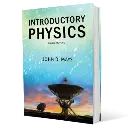
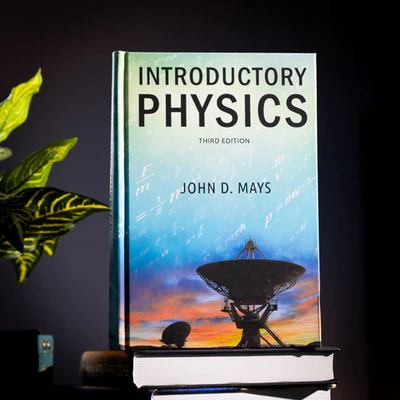
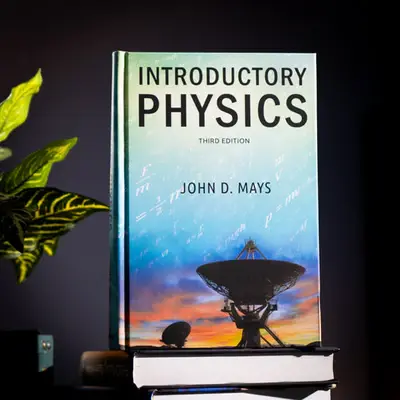
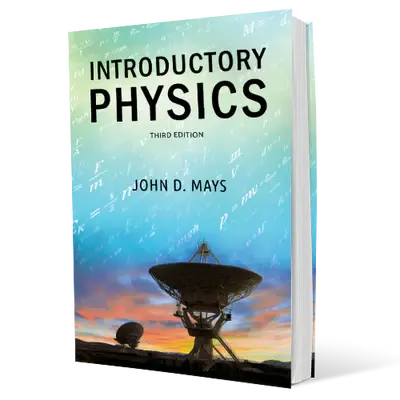
Introductory Physics
Introductory Physics is ideal for the "physics first" high school science program, which places a physics-based course in the freshman year. We believe physics logically belongs at the start of the high school science sequence because it includes so many foundational skills and concepts that chemistry and biology studies can build upon later. (For a full explanation of our recommended science sequence, please see this article.)
We understand, however, that many will need to place physics in 10th or 11th grade, so this book is adaptable for that purpose. Two optional chapters ("Pressure and Buoyancy" and "Geometric Optics") have been included with more challenging math content for those older students.
Students should be enrolled in concurrent algebra I to use this book, which is standard track mathematics for 9th grade. We make our exercises challenging, requiring students to utilize multiple concepts and skills to arrive at an answer, but nothing higher than basic algebra is required for this text. This book does not use trigonometry; for our advanced physics text, please see our other book, Physics: Modeling Nature.
All Novare textbooks uphold the Mastery-Learning paradigm, designed to break the Cram-Pass-Forget Cycle and promote long-term retention of course content. This paradigm appears in several essential methods, but the centerpiece is a weekly quiz assessment in which quizzes are fully cumulative (there are no chapter exams at this level). With cumulative quizzes determining a sizable portion of the grade, students must develop a new approach to their personal management of this class that includes regular review—we recommend about one-third of their time devoted to reviewing old quizzes and homework, and two-thirds for new material. The Digital Resources for Introductory Physics provide students with a sample study regimen in the Weekly Review Guides, with advice on how best to study each week. Chapter exercises are only calculations or full-sentence answers, never multiple choice or matching.
As with all NSM texts, Introductory Physics is written from the perspective of the historic Christian faith. Read about how we bring this about on our Textbook Philosophy page—it's different from other Christian publishers.
We place a lot of content dealing with the history of science in the body of the text, not in a sidebar where it can be ignored. Knowledge of this history of science is essential to understanding how science works. There is even a little philosophy exploring the nature of scientific knowledge—something you won't find elsewhere. Technical communication, both written and verbal, is emphasized.
If that wasn't enough, we take pride in producing physical books of top quality. Beautiful, relevant color graphics appear throughout as well as prose that is accurate, lucid and concise. Our beautiful hardbacks are sturdy and enduring. We use library quality, "smyth-sewn" binding so pages never fall out and the spine never cracks. And we prefer a page layout approach that is aesthetically sensitive, pleasing, and engaging.
Finally, the assigned experiments for this book focus on giving the student a genuine experience of a lab scientist, emphasizing proper procedures, safety consideration, materials disposal, lab journaling, lab report writing, precision vs. accuracy, handling apparatus, and accounting for unexpected results. Student instructions for 5 laboratory experiments are included in the appendix.
R 2,195.00
R 2,195.00
R 2,195.00
-
Curriculum
-
Subject
-
Subject
-
Level
-
Grade
-
Grade
-
Grade
| Curriculum | Classical Academic Press |
| Subject | General Science, Physics |
| Level | Highschool |
| Grade | Grade 9, Grade 10, Grade 11 |
| Curriculum: Classical Academic Press |
| Subject: General Science , Physics |
| Level: Highschool |
| Grade: Grade 9 , Grade 10 , Grade 11 |
Documents